



Heroing Won’t Save You This Year
When we work with leaders and teams, we spend a lot of time developing awareness of their below-the-line patterns. Self-awareness—the first key to conscious leadership— starts with recognizing whether we are below the line (in reactivity) or above the line (in presence).
We also spend hours helping leaders understand the drama triangle: Victim, Villain, and Hero. Recognizing which “base” you’re on, and how your reactive patterns play out in the triangle, is essential to eventually shifting to above the line.
Leaders often ask:
“When will we talk about being above the line?” “What does it look like to lead from above the line?”
To answer that, we introduce another model.
From Drama Triangle to Presence Circle
Just as Stephen Karpman introduced the Drama Triangle (circa 1968), David Emerald introduced The Empowerment Dynamic in The Power of TED. Over the years, we’ve adapted and expanded it into what we call the Presence Circle.
Here’s the essence:
When we’re below the line, we’re in the drama triangle.
When we’re above the line, we’re in the presence circle.
Like the drama triangle, the presence circle contains three roles:
- Victim becomes Creator
- Villain becomes Challenger
- Hero becomes Coach
Over the next few months, I’ll explore all three shifts. Today, I want to start with the one most leaders find confusing: the shift from Hero to Coach.
Why Heroing Seems Good (But Isn’t)
The confusion around the Hero role makes sense—our culture glorifies heroes. Superman is a hero. The soldier who throws themselves on a grenade to save their fellow soldiers is a hero. The team member who works tirelessly all night to salvage a key project from disaster is a hero. Heroes save the day.
In some ways, this is heroic. But in the world of conscious leadership, the Hero plays a specific reactive role. Heroes:
- Over-function
- Enable others to under-function
- Take more than 100% responsibility, while others take less than 100% responsibility
Furthermore, for the unconscious leadership game to be played, the Hero needs both a Victim and a Villain. Their identity requires someone else to be “in need” or disempowered. Or, at least, the hero needs to see others as unable to do it themselves.
And like every role in the drama triangle, heroing is rooted in threat or fear. When in fear, heroes often seek approval, control, or security. And, to them, it appears that they get all three by saving the day or rescuing the person or situation.
Most importantly, heroes seek temporary relief. They don’t address and resolve the root issue. They fix, patch, or rescue—what we call handing out “fish sandwiches” instead of teaching people how to fish. It takes longer to teach people how to fish, but if that doesn’t happen, the hero will keep returning over and over to hand out fish sandwiches.
The Hidden Costs of Heroing
Many workplaces and families reward heroes. Over-functioners get promoted, bonuses, and praise. They “save the day.” But at what cost?
Let’s look at Michael Jordan. When he joined the Chicago Bulls, many saw him as a hero. Phil Jackson, his coach, saw the problem: if Michael kept doing more than his 100%, the Bulls would never win championships.
Jackson convinced Michael—and the rest of the team—to each take just their 100% responsibility. Michael’s 100% included extraordinary things that only he could do. Dennis Rodman’s 100% was different but essential. So was Steve Kerr’s. If Michael over-functioned and the rest under-functioned, they’d never reach greatness together.
This dynamic plays out everywhere:
- The manager who rescues the team breeds dependency.
- The parent who does everything for the family creates dysfunction.
Over time, three things happen:
- The Hero burns out and becomes exhausted and resentful.
- The “Victims” feel disempowered—and resentful.
- The core issue never gets addressed and resolved.
Heroing is not sustainable.
Hero vs. Coach: Key Distinctions
Here are the main differences between heroes and coaches.
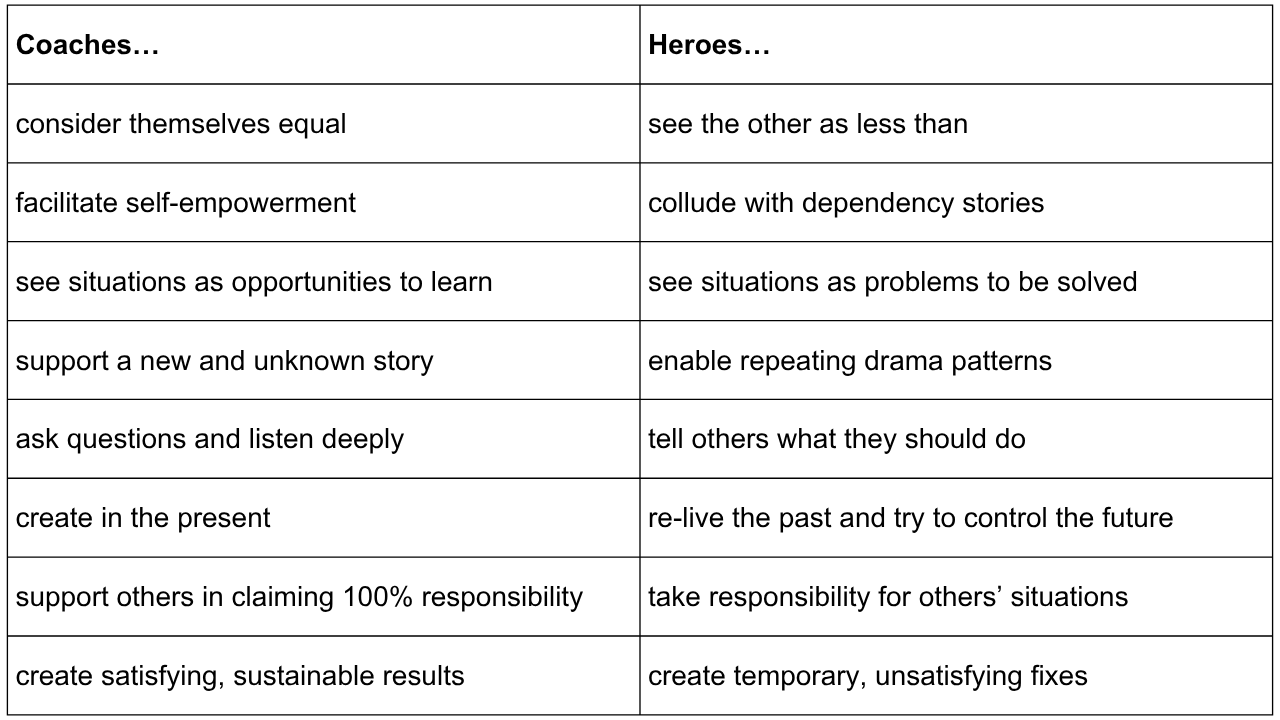
What Makes Someone a Coach?
When Heroes shift from seeking temporary relief to empowerment and trust, they become the Coach.
A Coach:
- Trusts that life is constantly offering learning opportunities that do not need to be controlled or resisted.
- Believes people are capable of creating their own lives
- Encourages responsibility without taking it on themselves
- Facilitates presence, growth, and alignment.
Coach's guide. They don’t fix. They support others in taking ownership. And when needed, a Coach can consciously shift into the Challenger role to provoke growth—without blame or control.
In order to master the role of Coach you must:
- Fully engage in your own life as a Creator
- See others as creators of their own lives
- Drop the story that others are in need of fixing
- See others as whole, resourceful, and creative
- Appreciate the value of pain and suffering
Want to Know If You're Heroing?
One of the most useful diagnostics is this: What kind of questions are you asking?
Coaches ask questions that…
- Invite presence
- Support clarity
- Encourage self-responsibility
- Open up new possibilities
Here are a few to start with:
- What do you want to create here?
- What are you learning right now?
- What’s your 100% responsibility?
- What’s possible if you trusted they were fully capable?
Stay Tuned
This is more than a leadership tactic—it’s a transformation of identity.
When you drop the armor of the Hero and step into the presence of the Coach, you don’t just change your leadership. You change your life.
Teams flourish. Families heal. Whole cultures evolve.
At CLG, we’ve watched thousands of leaders make this shift. Every time, the results are the same: more freedom, more aliveness, more trust.
The world doesn’t need more heroes. It needs leaders awake enough to Coach.
Will you be one of them?
In the next few posts I write, I’ll explore the other two shifts:
- Victim → Creator
- Villain → Challenger
These distinctions are essential if you want to learn to lead from above the line.
For now, just notice:
Where are you showing up as a Hero?
What would shift if you stepped into Coach instead?
As we move toward the end of the year, this is an ideal moment to pause and reflect.
Where are you leading from Hero energy—proving, protecting, performing?
And what might become possible if you shifted to Coach—curious, conscious, and fully present?
Tomorrow, we’ll release the 2025 Reflection Guide written by me and the CLG Leadership Team—the perfect tool to help you recognize and work with the very Hero patterns you may find yourself in. It’s designed to help you complete the year consciously, face where you’ve been rescuing or over-functioning, and begin 2026 from a new level of awareness, presence, and choice.
Stay tuned.
Related posts


